
In the first week, I collected cigarette butts from two different locations: a bin at CSM and the smoking area at Stapleton House.
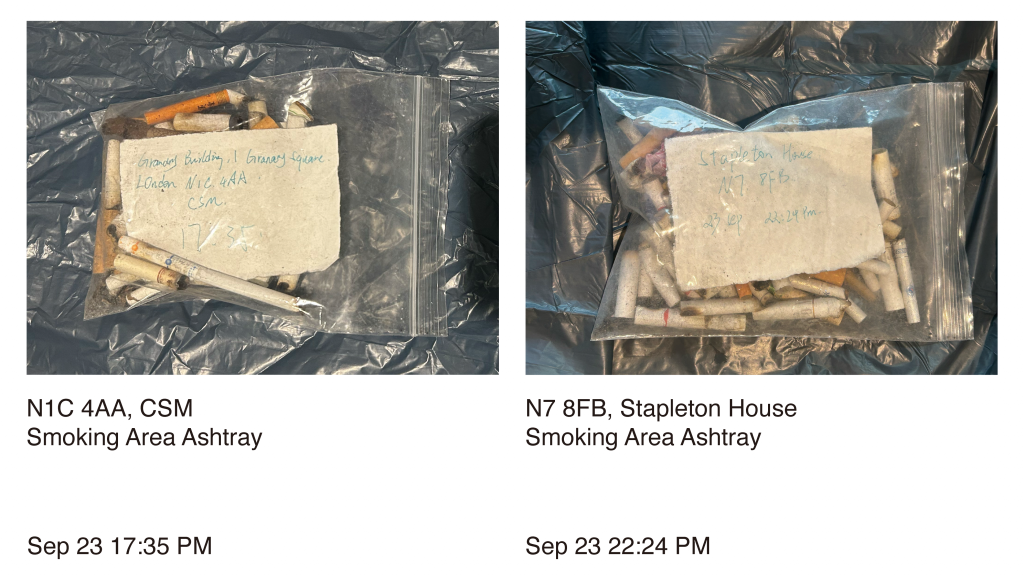
I did some basic sorting and classified them according to the country associated with each cigarette brand. I hoped that by comparing the two locations, I might be able to identify differences in the demographic makeup of the areas or people’s smoking preferences.
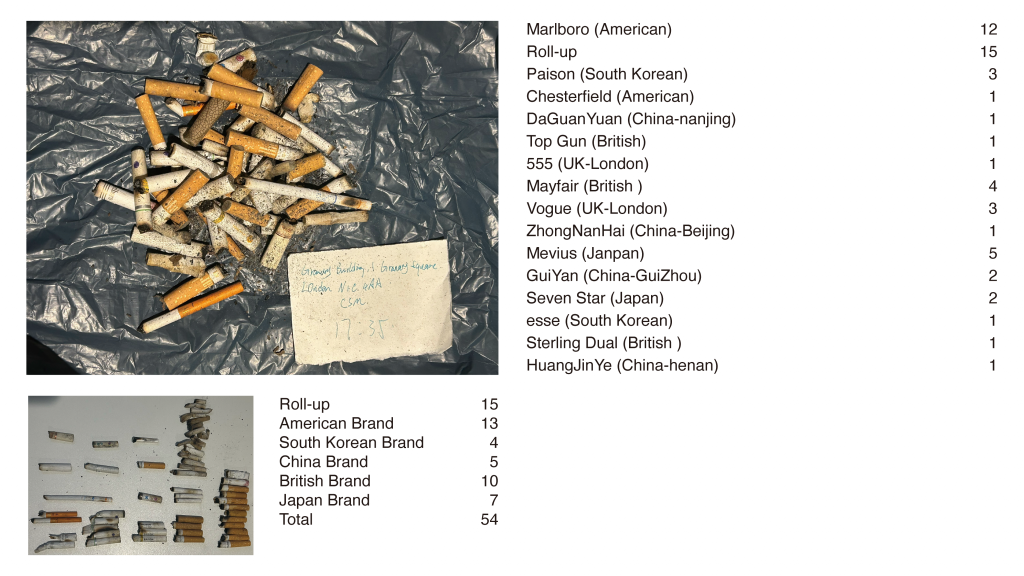
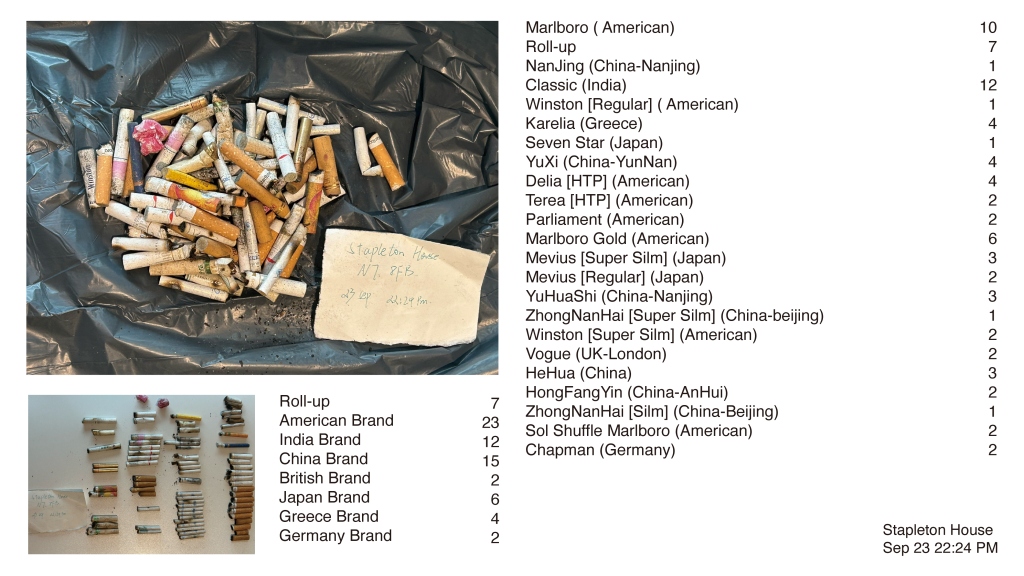
I also archived and organised the cigarette butts, trying to identify similarities and differences between them.
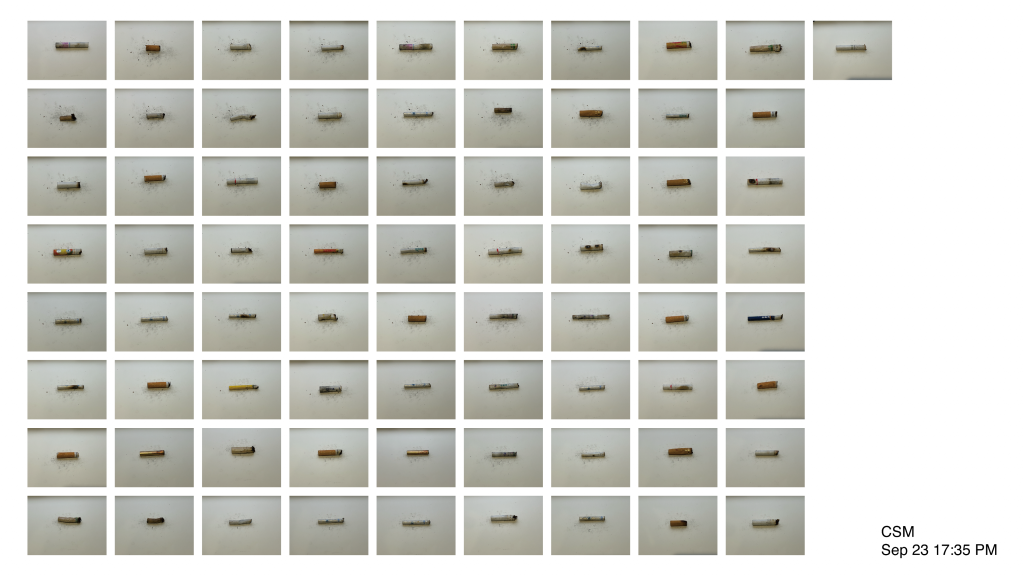
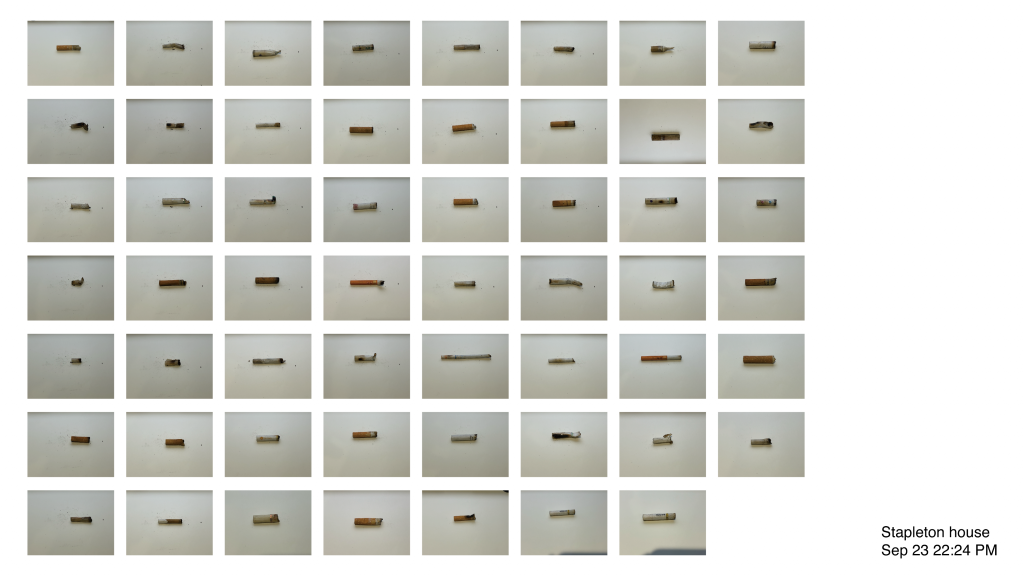
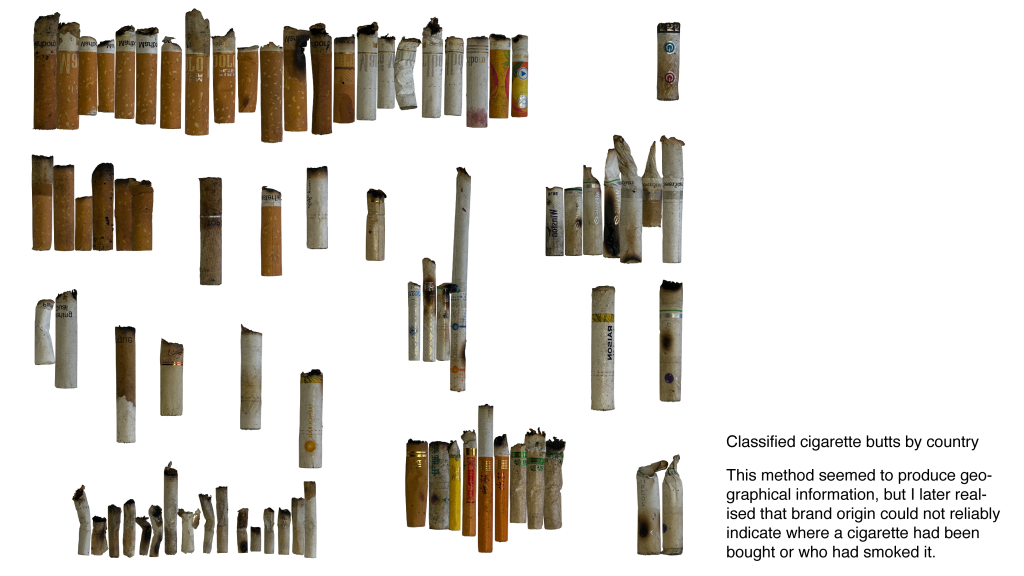
After the tutorial, however, Houman suggested that I focus on just one location. He also pointed out a problem with classifying cigarette butts according to the nationality of the brand. For example, if a British person travelled to Japan, bought Japanese cigarettes there, brought them back to the UK, and smoked them here, my record would still only identify the cigarette as Japanese. In other words, the brand’s country of origin could not reliably tell me where the cigarette was bought or anything definite about the person who smoked it.
So, in the second week, I began to focus on a single site. I chose a bin on Holloway Road. I stood beside the bin and observed the area, initially hoping to collect the cigarette butts that people discarded there after smoking.
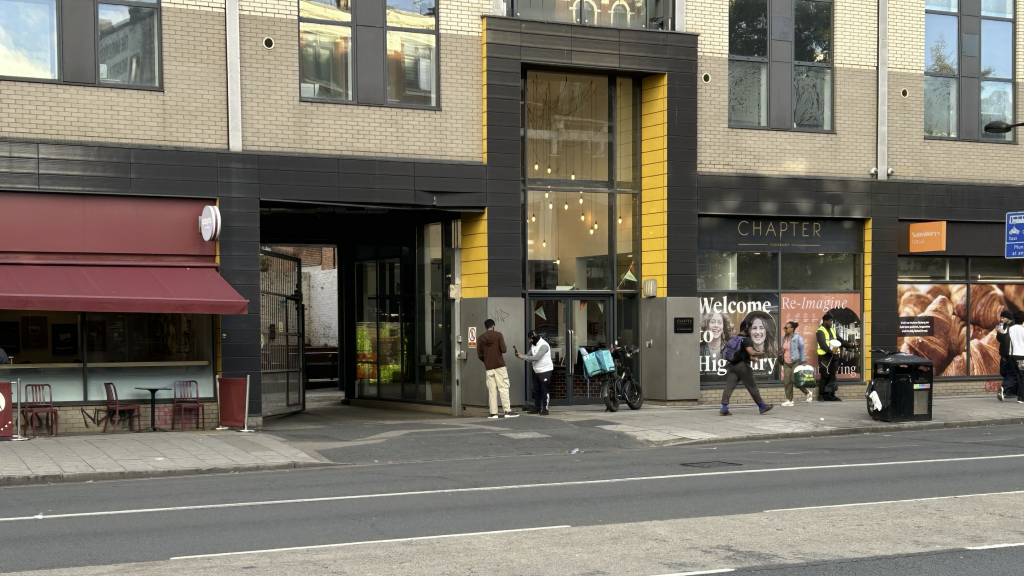
However, I quickly noticed something unexpected. Where I used to live, smoking is prohibited in many public places, so smokers tend to gather around bins with ashtrays. In the UK, however, I found that people often smoke while walking. As a result, it was difficult to collect enough cigarette butts from this single bin to produce a meaningful analysis.
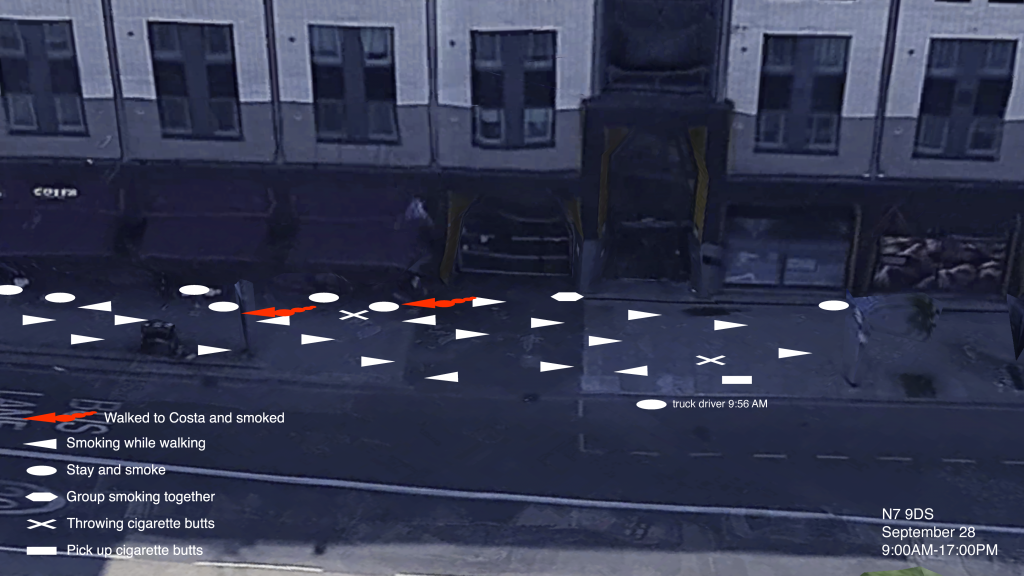
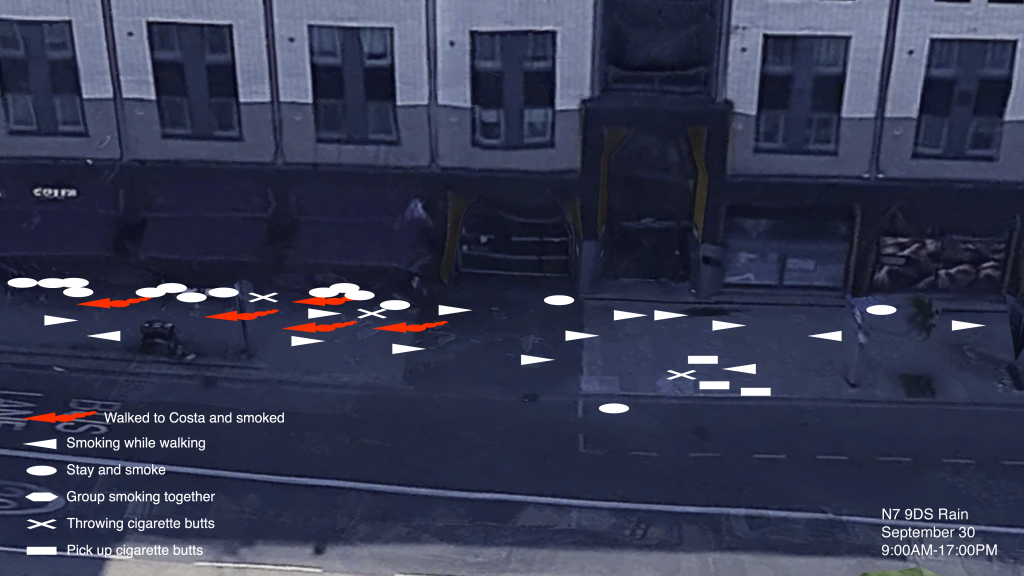
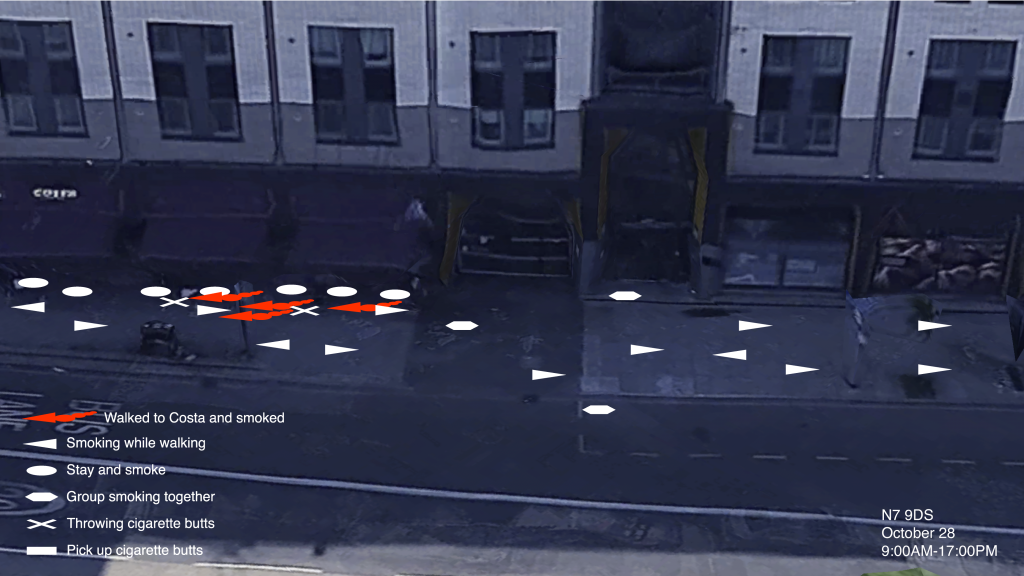
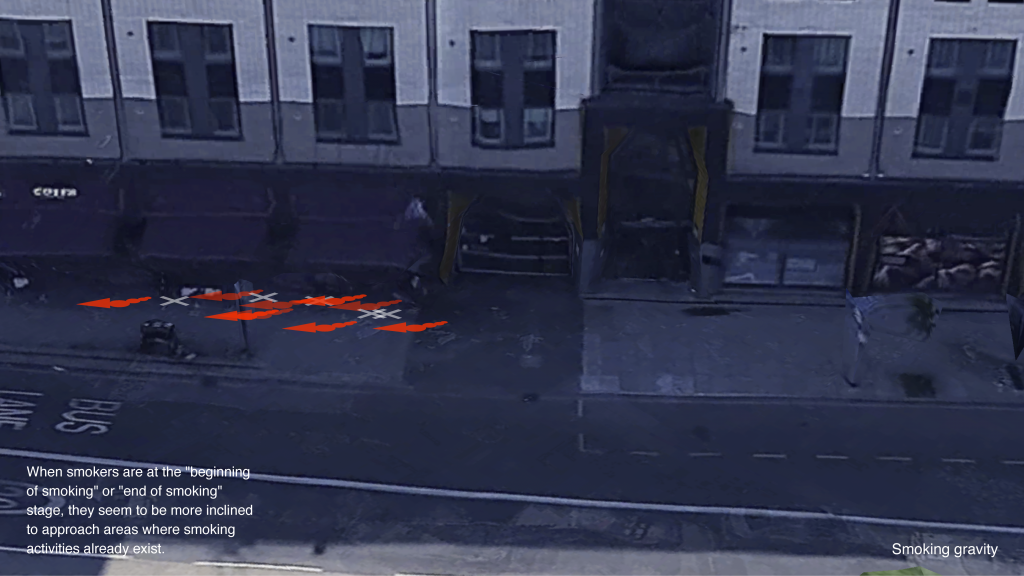
I therefore began observing and recording people’s smoking behaviour instead. I noticed what seemed to be an instinctive tendency among smokers to gather together. If people had already lit a cigarette and were smoking while walking, they usually continued moving rather than stopping. However, when they were about to start smoking, or when they were finishing a cigarette and looking for somewhere to dispose of the butt, they seemed more likely to move towards places where other people were already smoking, such as the outdoor area of Costa. Many people did not buy coffee, and even when there were no seats available, they would still stand there, smoke a cigarette, and then leave.
After the next tutorial, however, I decided to return to the cigarette butts themselves and reconsider what kinds of information they could actually provide. I began experimenting with different systems of classification and arrangement.I classified the cigarette butts by country / brand origin:
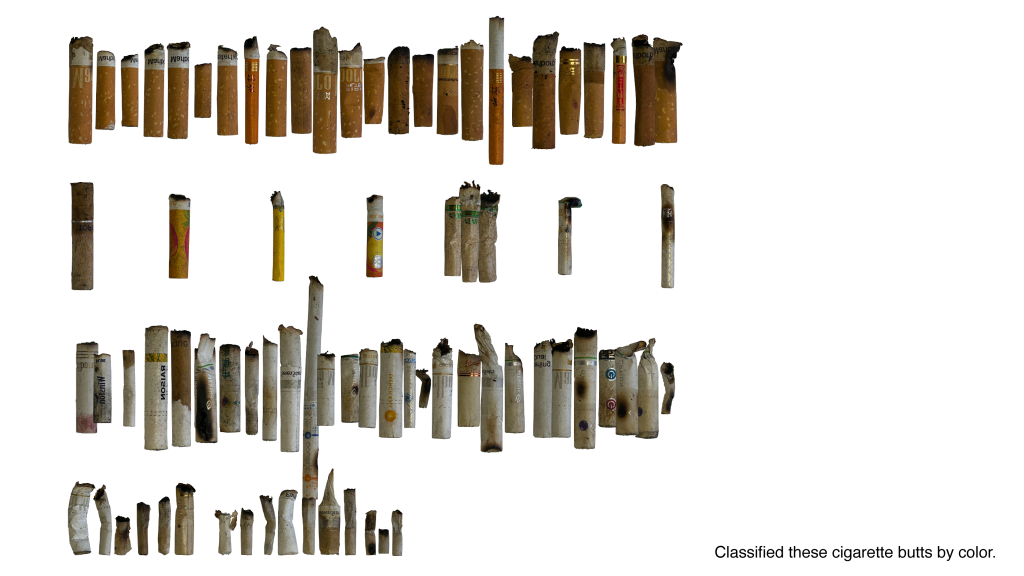
by colour:
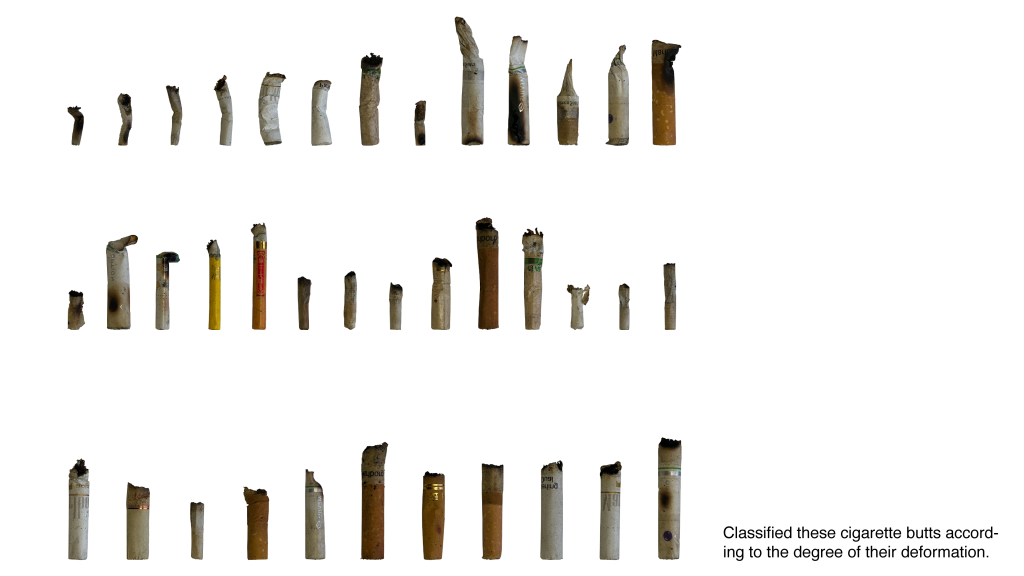
by the degree of deformation:
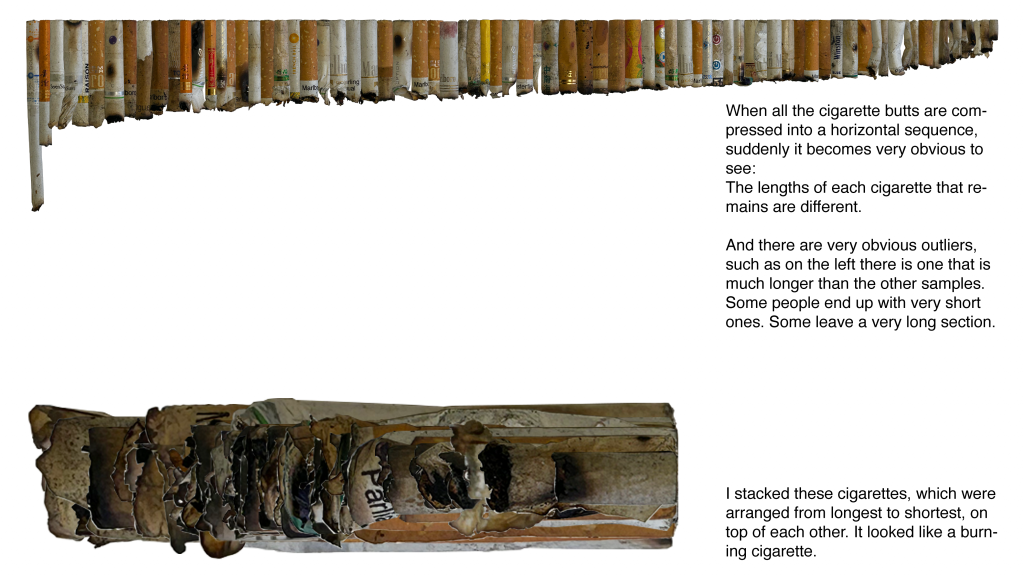
by their remaining length:
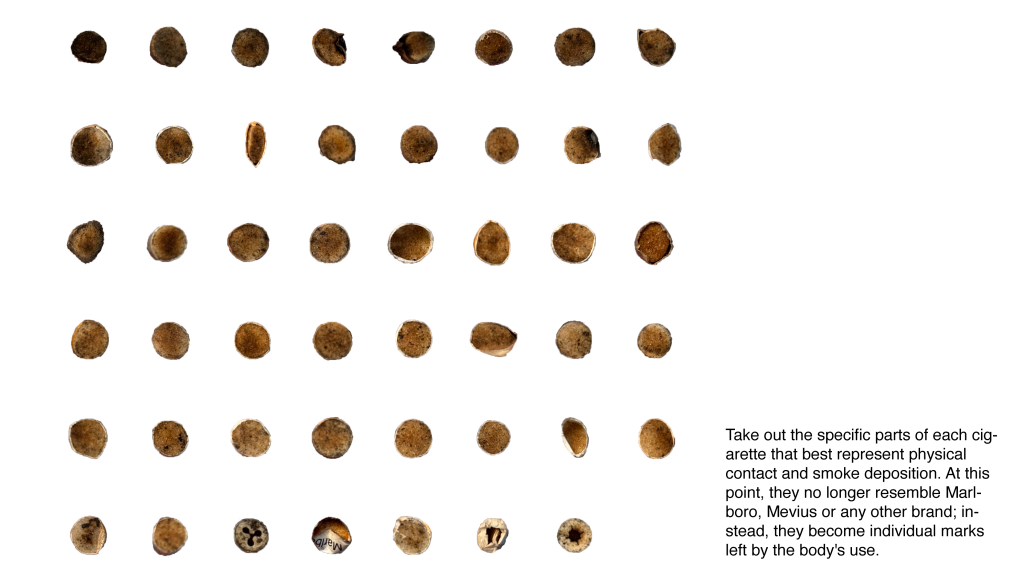
I then photographed the filters from above and classified them according to the differences in colour caused by smoke and tar deposition:
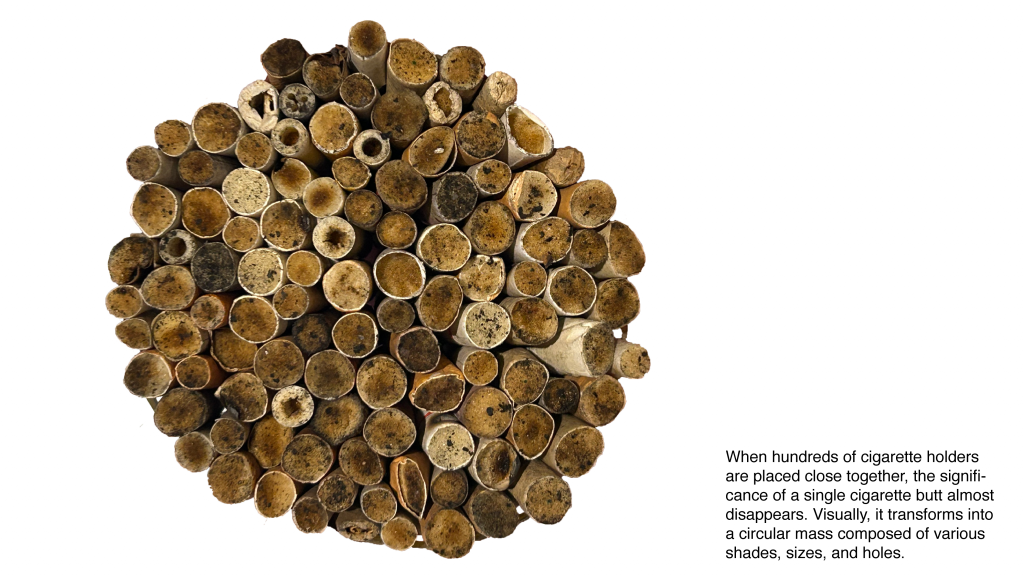
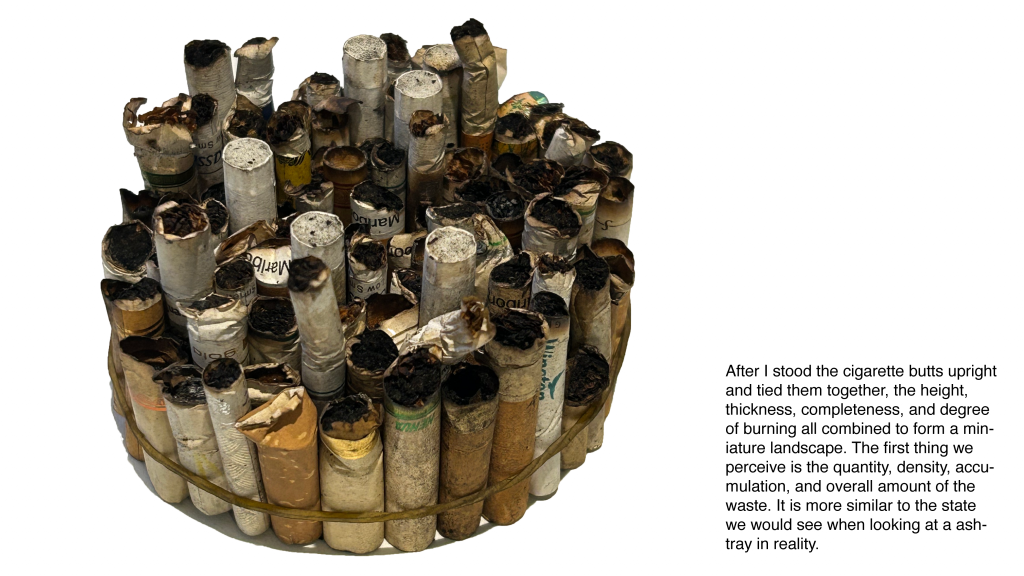
I brought them together into a dense group:
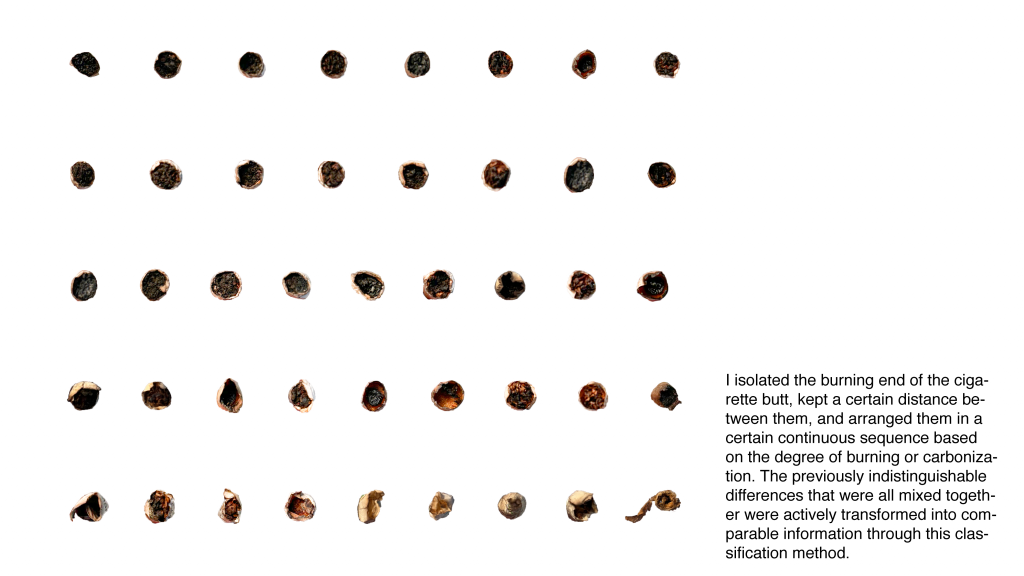
I isolated the burnt ends of the cigarette butts and classified them according to their degree of burning or carbonisation:
bringing them together again as a group:
At the beginning of this project, I hoped to use the information contained in cigarette butts to infer something about the outside world. I wanted to understand the stories of the people behind them. However, I gradually realised that the cigarette butts themselves did not provide enough evidence for me to make those kinds of assumptions or draw reliable conclusions.
As I continued to classify them, I began to notice something else: the same group of objects could produce completely different kinds of information depending on how they were classified, arranged, cropped, or combined.
Classification is not neutral. Each system of classification produces a different result. Whoever has the ability to define the criteria of classification, name categories, and determine the boundaries between them also holds a certain power to shape how reality is understood.
Every system of classification not only reveals information, but also removes or hides other information. When I classified the cigarette butts by country, their indentations, remaining lengths, and degrees of burning temporarily disappeared from view. When I classified them according to deformation, the brands moved into the background.
Classification is always a choice. It does not simply describe these cigarette butts; it structures the ways in which they can be understood.
writing:
Leave a Reply